Hello all,
Herein lies a mystery surrounded by mismatched partition sizes, reoccurring chkdsk errors, and a host if suspects (hey, I am trying to add some intrigue so someone will read this!).
Anyway, here it is:
2 Physical Hard Drives:
Drive 0: Western Digital wd1200jb-75cra0: NTFS, XP SP3
Drive 1: IBM-DTLA-305020: Linux
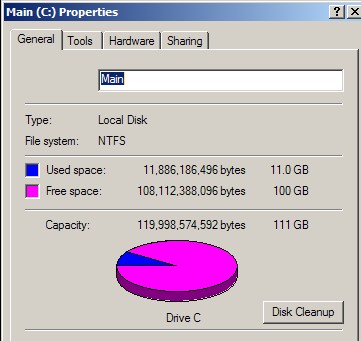
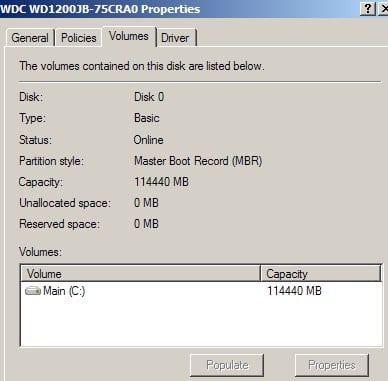
Now, The Western Digital has a capacity of 120 GB (know this for a fact), but it is being reported either correctly by the "Properties/General" tab (see "general.jpg" image), or incorrectly by the "Properties/Volume" tab (see "volumes.jpg") and from "computer management/disk management" (see "disk-management.jpg").
The utility "Partition Wizard 4.1 Boot CD" also incorrectly notes the NTFS volume is around 11.4 GB (with no available free space before or after).
The size of the IBM drive is reported correctly.
Further, from a boot-time chkdsk /r as noted in:
Application/Event Viewer/Winlogon:
Checking file system on C:
The type of the file system is NTFS.
Volume label is Main.
A disk check has been scheduled.
Windows will now check the disk.
Cleaning up minor inconsistencies on the drive.
Cleaning up 12 unused index entries from index $SII of file 0x9.
Cleaning up 12 unused index entries from index $SDH of file 0x9.
Cleaning up 12 unused security descriptors.
CHKDSK is verifying Usn Journal...
Usn Journal verification completed.
CHKDSK is verifying file data (stage 4 of 5)...
File data verification completed.
CHKDSK is verifying free space (stage 5 of 5)...
Free space verification is complete.
117186108 KB total disk space.
11376596 KB in 44768 files.
14900 KB in 4850 indexes.
0 KB in bad sectors.
172900 KB in use by the system.
65536 KB occupied by the log file.
105621712 KB available on disk.
4096 bytes in each allocation unit.
29296527 total allocation units on disk.
26405428 allocation units available on disk.
Internal Info:
40 05 01 00 dd c1 00 00 da 14 01 00 00 00 00 00 @...............
ef 00 00 00 02 00 00 00 d4 04 00 00 00 00 00 00 ................
72 9c c2 01 00 00 00 00 1a 22 21 1b 00 00 00 00 r........"!.....
8a d6 82 03 00 00 00 00 ac e5 14 44 01 00 00 00 ...........D....
34 87 2a 64 06 00 00 00 ec 83 a7 d1 07 00 00 00 4.*d............
99 9e 36 00 00 00 00 00 88 38 07 00 e0 ae 00 00 ..6......8......
00 00 00 00 00 50 5f b6 02 00 00 00 f2 12 00 00 .....P_.........
Windows has finished checking your disk.
Please wait while your computer restarts.
=========================================
I have also ran it in chkdsk /f mode.
Sometimes the errors are corrected, but inevitably re-occur.
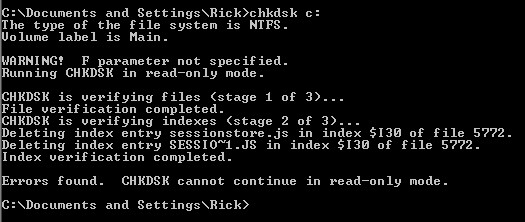
From run/cmd/chkdsk the Firefox is frequently pointed at as having problems (see chkdsk.jpg).
Now, my XP is a recent install - around 2 weeks ago.
I wiped clean my WD drive, then installed XP and all the latest service packs.
I have ran WD's disk diagnostic utility, as well as "HD Tune", both of which show the drive to be healthy, without errors, and S.M.A.R.T. checking out as ok.
Various scans by different AV products show no malware concerns.
I have a fair knowledge of computers, but sometimes, I have a time figuring out if problems I encounter are separate issues, or connected in some manner - in this case, chkdsk errors and partition size disparities.
Hope this abundance of info I provided didn't make this even MORE confusing :(
If anyone has the time and would like to help me out with this, I would appreciate it :)
Thx,
Rick