Hi,
Somehow system is stopped showing the ‘D’ Drive in Windows Explorer.
Did check in Disk Management but could not see the drive or unallocated space.
Please suggest.
Regards,
Steve
Hi,
Somehow system is stopped showing the ‘D’ Drive in Windows Explorer.
Did check in Disk Management but could not see the drive or unallocated space.
Please suggest.
Regards,
Steve
Since confirmed this is a second partition on the internal HDD and Disk Management showed nothing, treat this as a lower‑level detection or partition‑table issue rather than a simple Explorer quirk. The safest approach is a short, non‑destructive checklist followed by read‑only inspection and recovery attempts if needed.
First, rule out simple hardware/firmware causes: power the machine down and reseat the SATA/power cable or try a different SATA port; check BIOS/UEFI to see whether the physical drive is detected. If the drive disappears from BIOS, stop and fix the cabling or controller before touching Windows. If the drive appears in BIOS but not in Windows, avoid initializing or formatting anything that prompts Windows — that can destroy recoverable data.
Next, collect diagnostics without writing to the disk. In Windows use the built‑in disk utility in read mode (or run diskpart to list what Windows currently sees). From a Linux live USB (Ubuntu, SystemRescue, etc.) run read‑only tools to inspect the partition table and SMART data:
# Windows (diskpart)
diskpart
list disk
list volume
exit
# Linux (run from a live USB)
sudo fdisk -l
sudo smartctl -a /dev/sdX # smartmontools (read-only)
sudo testdisk # interactive partition recovery (read-only by default) If the disk shows as present but partitions are missing, common causes are a corrupted MBR/GPT, accidental deletion by partitioning tools, or file‑system corruption. Tools such as TestDisk can often restore a lost partition table without writing user data. If the filesystem shows as RAW, do not initialize or format; instead try recovery/export with TestDisk, PhotoRec, or a dedicated recovery app.
Prioritize a full image if the data is important: create a read‑only disk image before attempting fixes (ddrescue on Linux). If SMART reports imminent failure or the drive is noisy, stop and consult a professional recovery service. Notes: , and raised useful diagnostic angles; start with hardware/visibility (BIOS), then move to read‑only inspection and recovery—never initialize/format if you need to preserve data.
Jump to Post— rch1231 169Hello,
If that is your CD-ROM/DVD drive like in most windows systems now a days then the solution could be as simple as putting a disk in the drive. I know on my Windows 7 desktop system when there is no disk in the drive it is not visible on …
Jump to Post— CimmerianX 197Good question. Is it a CD or a 2nd HD?
Does the Disk show up in Disk Manager?
Hello,
If that is your CD-ROM/DVD drive like in most windows systems now a days then the solution could be as simple as putting a disk in the drive. I know on my Windows 7 desktop system when there is no disk in the drive it is not visible on Explorer. If it is not your CD-ROM then I would go into Control Panel, Device Manager and look under Drives to see what device drivers are loaded. In Disk Management did you look at the bottow to see if the drive was there or only at the top listing?
Good question. Is it a CD or a 2nd HD?
Does the Disk show up in Disk Manager?
Thank you for reply.
This is a 2nd Partition on same internal HDD and not a DVD drive.
Regards,
Steve
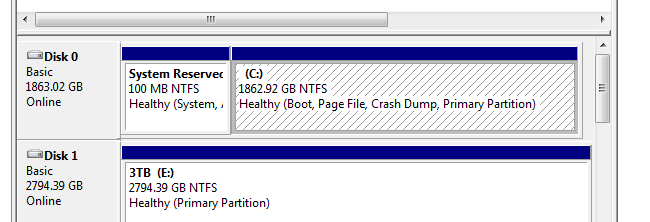
If the drive is on the same disk then when you go into Administrative Tools, Computer Management, then Disk Management. In the center frame you will see the Volume List at the top and a Graphical Representation of the drives at the bottom. If you look at the drive in question in the bottom of the center frame you will be able to see any partitions that exist on the drive. If the partition has a drive letter assigned it should show here and it will also show if the partition is formatted and the format used something like mine are shown in the attached image.
If the partition still exists but simply does not have a drive letter assigned you can assign one by right clicking on the partition and selecting Assign Drive Letter or Path. Let us know what you find if you are still having problems after this.
The next question then is which version of Windows are you running? I am running Windows 7 and if you notice my primary HD has a System Reserved partition and it does not have a drive letter assigned. This is normal for Windows 7 as it boots from the System Reserved partition and switches the second partition to have the drive letter C: during the boot process.
It may have been helpful to specity if you "D" drive is removable such as a NAS for example. If that is the case here, please specify the unc with \ -\ and not // to see and access the drive. This can be especially true in the current windows version.
You indicated that the drive was previously visible, so try this and let me know.
We're a friendly, industry-focused community of developers, IT pros, digital marketers, and technology enthusiasts meeting, networking, learning, and sharing knowledge.